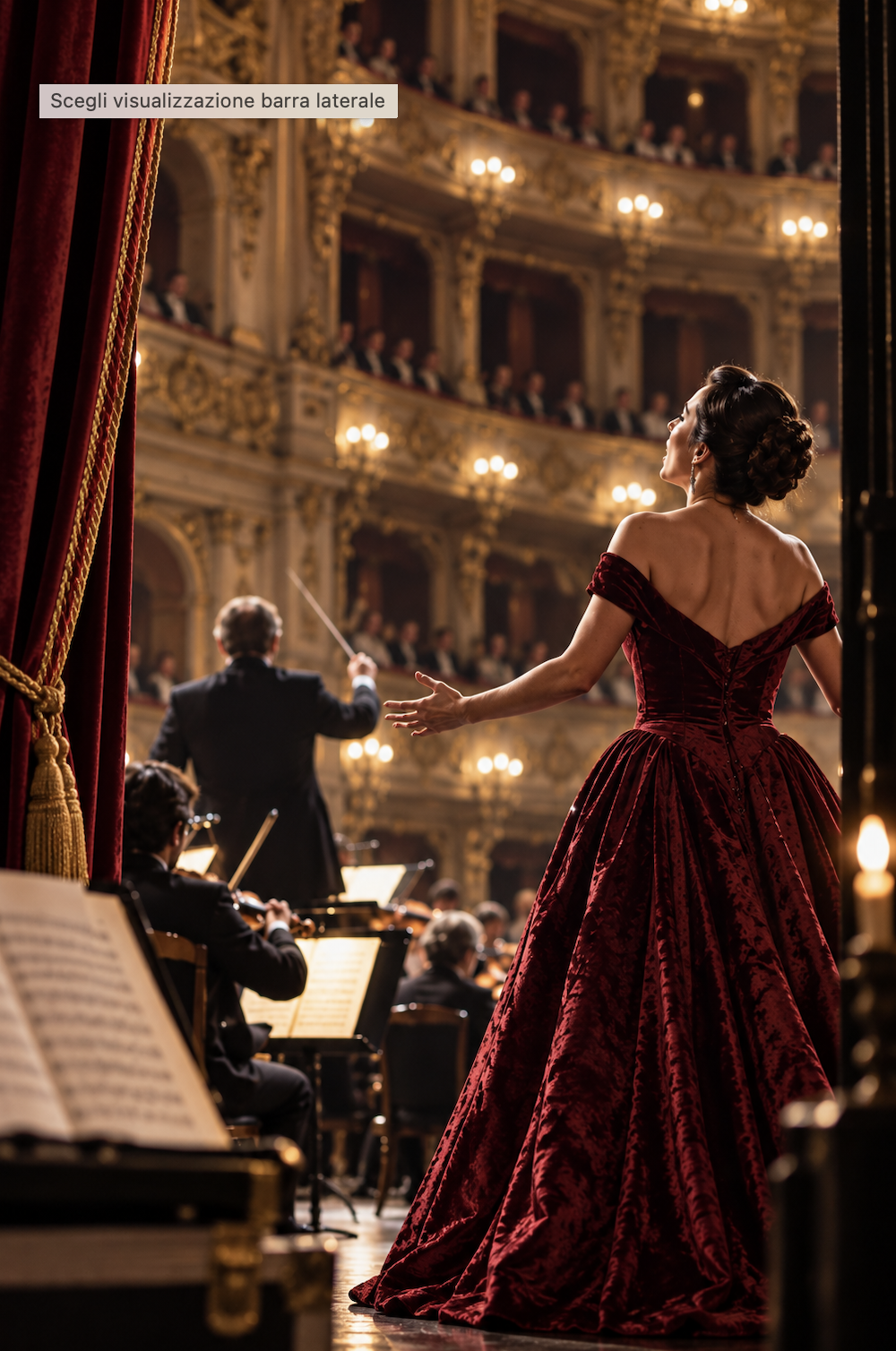
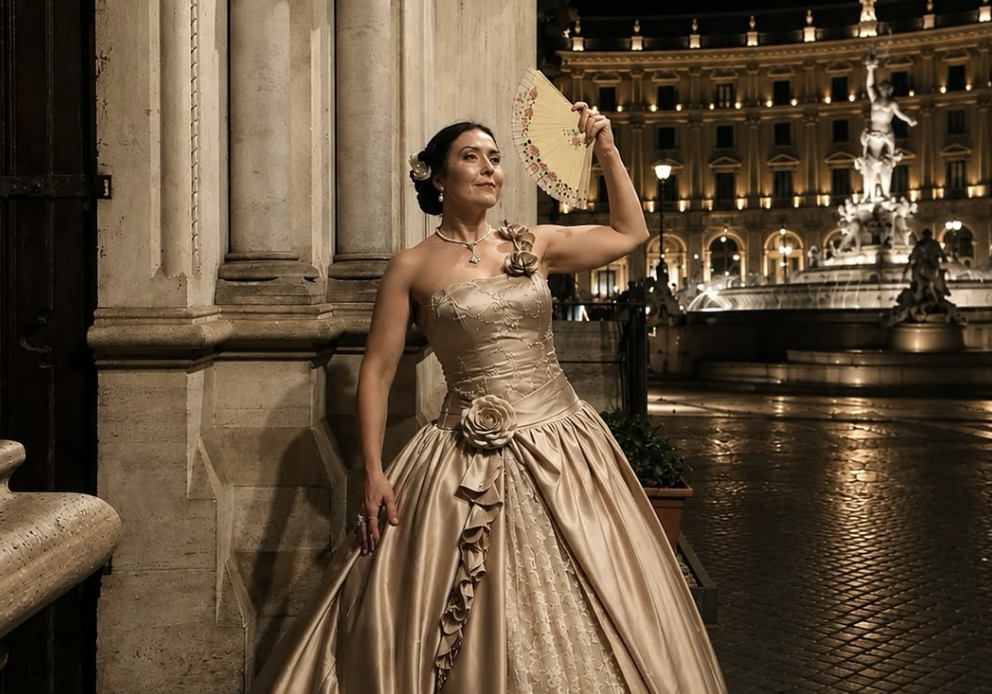
Before she steps onto the stage, Violetta comes to life in front of a mirror. Costumes, jewellery, hair and make-up become part of the character, telling us something about her world before she sings a single note.
Before the first note
When Violetta steps onto the stage, the audience already knows something about her.
She has not yet needed to tell us her story. Her dress, jewellery, hairstyle and make-up have already begun to do so. In the theatre, a costume is never simply something a character wears: it is one of the first ways we begin to understand them.
Yet what the audience sees in a matter of seconds is the result of a transformation that began much earlier, away from the stage, among dressing rooms, mirrors, costumes and last-minute details.
Becoming Violetta
Violetta Valéry is one of the most fascinating female characters in the history of opera. Elegant, independent and desired, she belongs to the glittering world of Parisian society. Yet behind that confidence lies a vulnerability that gradually emerges as her story unfolds.
Costume and make-up help make these two sides of Violetta visible: the public woman, surrounded by elegance and society, and the more intimate, fragile woman the audience gradually discovers through Giuseppe Verdi’s music.
A costume is never just a costume
In Opera e Lirica’s production of La Traviata, sets and costumes are created by Bolero Sartoria.
Fabrics, silhouettes, embroidery and accessories help recreate the elegant world inhabited by Violetta, Alfredo and the other characters. On stage, every detail takes on a different significance: something that may appear small up close must still be able to tell a story to someone sitting at the other end of the hall.
This is why a piece of jewellery, a hairstyle or the silhouette of a dress can become as much a part of the storytelling as the scenery itself.
Make-up designed for the stage
Stage make-up follows very different rules from everyday make-up.
Stage lighting can soften facial features, while distance changes the way the audience perceives expressions. Eyes, lips and facial contours therefore need enough definition to remain visible from the auditorium while still allowing the character to feel natural.
For Violetta, this balance becomes particularly important. Her appearance accompanies a story that moves from the brilliance of Parisian society to the profound vulnerability of the opera’s final moments.
What happens behind the scenes
The audience sees the finished result. Behind the scenes, time moves differently. A dress is adjusted, a hairstyle checked, an accessory prepared for the next entrance. Between scenes, everything must happen quickly, while the story continues on stage. It is a part of the theatre that usually remains invisible. And perhaps that is precisely what makes it so fascinating: while the audience follows Violetta, Alfredo and Germont, behind the scenes everything must be ready to ensure that the illusion is never interrupted, not even for a moment.
When the artist disappears and the character remains
There is a particular moment, just before stepping onto the stage, when the transformation seems complete.
The costume is ready. The make-up is finished. The sound of the orchestra can be heard from the auditorium. Then the singer steps onto the stage and, in the eyes of the audience, she is no longer simply a performer.
She is Violetta. Perhaps this is one of the little secrets of theatre: in the end, all the work required to create the illusion must become invisible.
Experience La Traviata in Rome
Every week, Giuseppe Verdi’s La Traviata comes to life in the remarkable setting of St. Paul’s Within the Walls, in the heart of Rome, performed by the soloists, choir and orchestra of Opera e Lirica.