
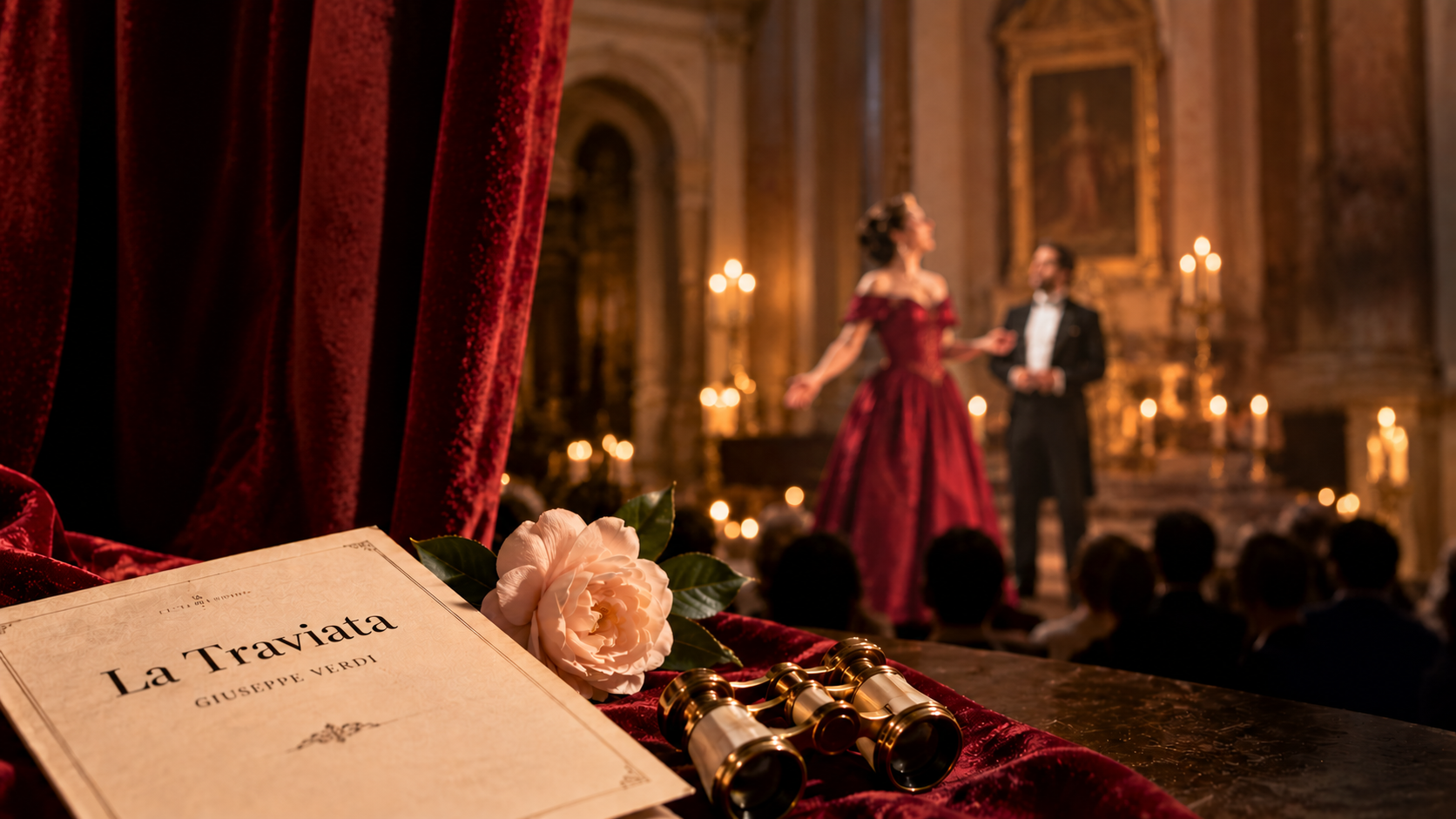
La Traviata in 10 Minutes: Everything You Need to Know Before You See It
A love story, a Parisian party, a sacrifice, and some of the most famous melodies in the history of opera.
If you are about to see La Traviata for the first time, you don’t need to study the libretto or know the opera by heart. Ten minutes is all you need.
Knowing a little about the story, meeting the main characters and recognising some of its most famous arias can make the experience even more moving.
First things first: what is La Traviata?
La Traviata is an opera in three acts by Giuseppe Verdi, with a libretto by Francesco Maria Piave, inspired by Alexandre Dumas fils’ La Dame aux camélias. It premiered at Teatro La Fenice in Venice on 6 March 1853.
But let’s forget dates and definitions for a moment.
La Traviata is, above all, the story of Violetta Valéry — a free-spirited, brilliant and much-admired woman in 19th-century Paris who discovers love just as her time is beginning to run out.
And perhaps that is exactly what makes her story feel so universal, even today.
The three characters you need to know
Violetta Valéry is the heroine of the story. A celebrated courtesan at the heart of Parisian high society, she is accustomed to parties and an apparently carefree, independent life. But she is seriously ill. Written for soprano, Violetta is one of the most iconic female roles in opera.
Alfredo Germont is a young man deeply in love with Violetta. Unlike the other men around her, he does not see her simply as a woman to pursue: his love for her is sincere. Alfredo is sung by a tenor.
Giorgio Germont, a baritone, is Alfredo’s father. He is the man whose intervention will change the fate of the two lovers.
Act I — A party, a toast and an encounter
We are in Paris. Violetta is hosting a lavish party at her home. Among the guests is Alfredo Germont, who has already been in love with her for some time.
And this is where we hear a melody you will almost certainly recognise, even if you have never seen an opera before:
“Libiamo ne’ lieti calici”
This is the famous Brindisi, or Drinking Song, from La Traviata. Alfredo sings, Violetta answers, and eventually all the guests join in the toast.
It is champagne, celebration and joy.
Yet Verdi quickly lets us sense that something else lies beneath all that light-heartedness.
Violetta suddenly feels unwell. Alfredo stays behind and confesses his love for her.
When everyone has gone, Violetta is left alone.
Could she really fall in love?
For a moment, she seems to believe it might be possible. Then she tries to convince herself that her life must continue as before: free, glamorous and without ties.
And she launches into another of the opera’s most famous arias:
“Sempre libera”
Violetta declares her determination to remain free.
But as she sings, Alfredo’s voice can be heard in the distance.
And we already know that something has changed.
Act II — Love has a price
Several months have passed.
Violetta has left Paris and is living in the countryside with Alfredo. She has given up her former life for him.
It looks like a happy ending.
But we are only in Act II.
Giorgio Germont, Alfredo’s father, arrives.
He asks Violetta to leave his son. Their relationship — and her reputation — is causing difficulties for the Germont family and threatens the marriage prospects of Alfredo’s sister.
It is one of the most painful moments in the opera.
At first, Germont sees Violetta through the prejudices of society. But as he speaks to her, he begins to understand the extraordinary woman standing before him.
Violetta agrees to sacrifice her own happiness.
But she decides not to tell Alfredo the real reason.
She leaves him, allowing him to believe that she no longer loves him.
The scene that changes everything
Violetta returns to Paris and attends a party.
Alfredo is there too.
He is hurt, jealous and furious. He still does not know the truth.
In front of the other guests, he humiliates Violetta by throwing money at her, as though he were “repaying” her for the time they spent together.
It is a terrible gesture.
Even his own father condemns him.
And this is one of the moments when La Traviata definitively becomes more than a love story.
It becomes a story about judgement, pride and the power of society to destroy a person.
Act III — “Addio del passato”
We are still in Paris.
But everything has changed.
The parties, elegant dresses and champagne toasts seem to belong to another world.
Violetta is in her room, gravely ill.
Alfredo finally knows the truth: he has discovered that Violetta left him only to protect him and his family.
He rushes to her side.
For a moment, the two lovers still imagine that they might leave Paris and begin a new life together.
But it is too late.
Violetta dies in Alfredo’s arms.
And Verdi creates one of the most heartbreaking moments in opera: in her final moments, Violetta suddenly seems to regain her strength.
For one brief instant, she believes she has returned to life.
Then everything ends.
4 musical moments to listen for
If this is your first Traviata, don’t try to remember everything.
Simply listen for these four moments:
🥂 “Libiamo ne’ lieti calici”
The famous Brindisi. You will probably recognise it from the very first notes.
❤️ “Un dì, felice, eterea”
Alfredo’s declaration of love to Violetta.
✨ “Sempre libera”
Violetta tries to convince herself that love will not change her life.
💔 “Addio del passato”
Alone and gravely ill, Violetta says goodbye to her dreams.
If you recognise even just these moments, you will already have a small musical map to guide you through the opera.
A curious fact: La Traviata was initially a failure
Today, it seems almost impossible to believe.
And yet the 1853 premiere at La Fenice was not the success Verdi had hoped for.
The opera returned to Venice the following year at the Teatro San Benedetto, with revisions and a different cast, and finally achieved great success.
There was another reason why La Traviata was so surprising to audiences at the time.
Verdi had chosen a contemporary subject, inspired by the life of a real courtesan, Marie Duplessis, who had died at a very young age.
This was something very different from the kings, heroes and stories set in distant times that opera audiences were accustomed to seeing on stage.
Why does La Traviata still move us today?
Perhaps because beneath the gowns and elegance of the 19th century lies a story that feels remarkably modern.
A woman judged for the life she leads.
A man who loves her but does not immediately understand her.
A family concerned with appearances.
And a person willing to give up her own happiness to protect the happiness of someone she loves.
La Traviata is about love, certainly.
But it is also about freedom, reputation, prejudice, sacrifice and time.
And when, at the beginning of the opera, everyone raises a glass and sings Libiamo, we know something they seem determined to forget:
the party cannot last forever.
Before you go to the opera
Don’t worry about understanding every single word.
Follow Violetta.
Listen to how her music changes: brilliant and virtuosic at the beginning, increasingly intimate and fragile as the story unfolds.
And above all, don’t think you need to “understand” opera before you can enjoy it.
Let the music tell you the rest.
Because some stories can be read.
Others have to be heard.
Experience La Traviata in Rome
Ready to experience the story for yourself? Opera e Lirica presents La Traviata every Saturday in Rome, in the beautiful setting of St. Paul’s Within the Walls Church.
After discovering Violetta’s story, there is only one thing left to do: hear it live.